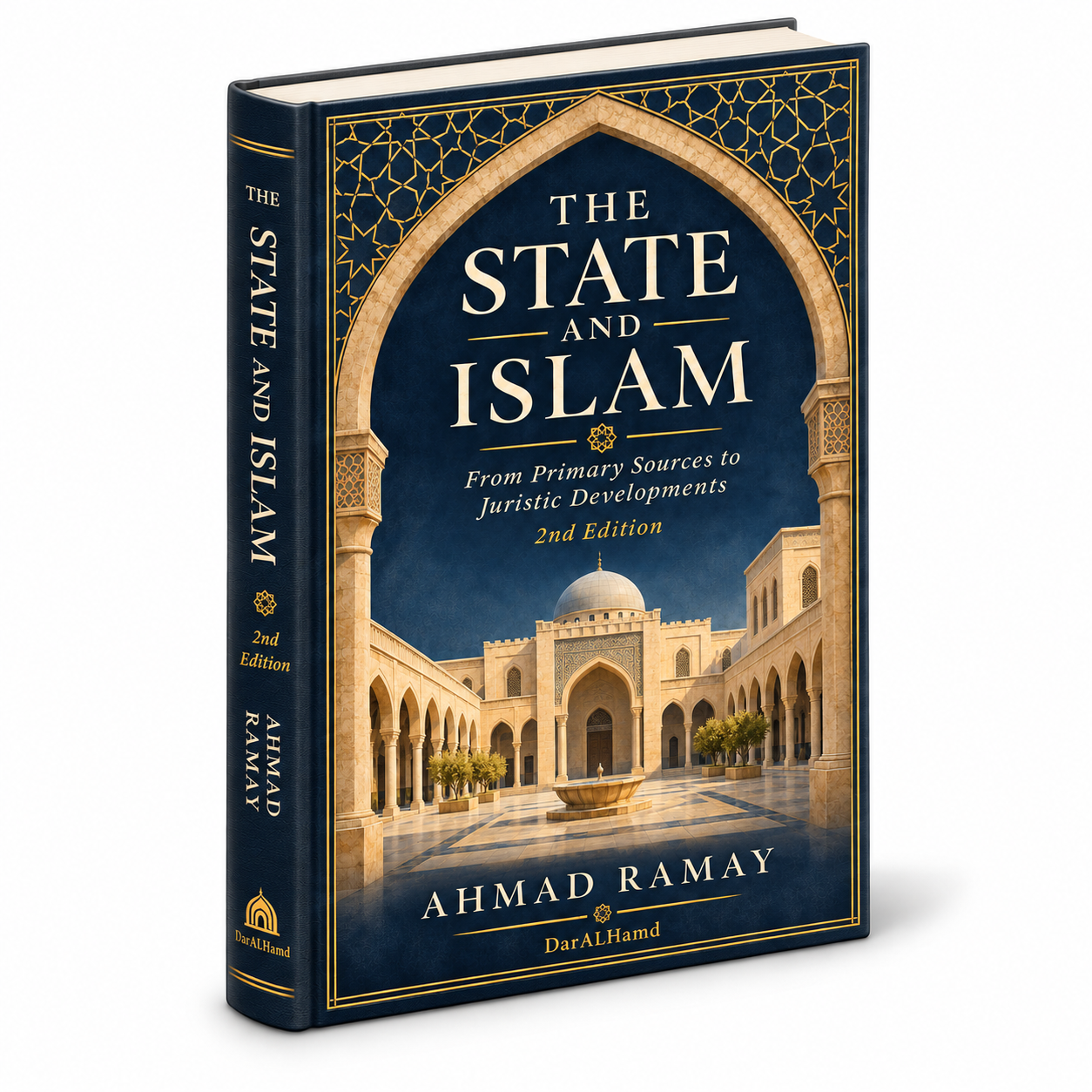
The State and Islam: Authority, Justice and Accountability — 2nd Edition
DarALHamd Research & Reflection · Ahmad Ramay
Updated 9 November 2026: the expanded 2nd Edition is now available as a free PDF.
Short summary
What gives political authority its legitimacy, and what keeps it accountable? Ahmad Ramay’s seven-chapter study examines foundational texts, early agreements, classical jurisprudence and modern constitutional arguments. This expanded second edition develops the public-finance inquiry: the author distinguishes administration of civic affairs from an autonomous state claim over private wealth, engaging opposing jurisprudence, household hardship and the stewardship of public resources.
From a moral duty to a public institution
A command to judge fairly does not by itself specify an appointment process, a constitution or a method of removing a ruler. The book examines the additional reasoning through which jurists constructed those arrangements. It treats that reasoning as historically significant and open to evaluation.
Obedience and correction
The evidence places substantial weight on public order while also preserving limits on obedience and duties of truthful counsel. The study considers how these commitments interact, including the distinction between condemning wrongdoing and determining the lawful response to it.
What is new in the second edition?
The expanded Chapter 7, especially sections 7.12–7.18, distinguishes authority to administer civic affairs from a claim to private earnings. It separates acquisition from allocation, examines specified financial duties and early fiscal practice, and tests the restrictive thesis against opposing juristic arguments. Household subsistence, taxes on essential goods, market privilege, public assets and need-linked funding receive sustained attention.
Why public finance matters
Taxation makes claims of authority concrete. A demand for payment requires an account of the obligation, the collector’s competence, the intended beneficiaries and the permitted uses of the receipts. The fiscal chapter connects these questions to the book’s wider inquiry into accountability.
Conclusion
Public authority remains answerable to the duties invoked to justify it. In the expanded fiscal chapter, the author argues that administrative competence does not itself establish unrestricted fiscal sovereignty. Any additional compulsory assessment requires a justified obligation, an appropriate basis, protection of subsistence and limits tied to demonstrated need. This is the author’s restrictive position within a contested juristic discussion, not a claim of universal agreement.
Read the complete book
The State and Islam — 2nd Edition · 220 pages · English · Free PDF for adult readers.
Download the free book — 2nd Edition View book details
Research scope
A source-based research monograph for adult readers. The author’s comparative analysis is distinct from a fatwa. The selected foundational corpus and the evidentiary limits of historical documents are explained in the book.
Sources and further reading
- Read the book’s chapter source registers and consolidated bibliography
- Pakistan National Assembly constitutional resources
The complete argument, citations and qualifications are provided in the linked book. This article summarises the author’s study; it does not claim independent peer review.
Continue learning with DarALHamd Books and our free courses.

You may also like
Interest and Islamic Banking: Contracts, Risk and Financial Justice