Housing Tax Reform: Affordability, Ownership and Corporate Landlords
DarALHamd Research & Reflection · Ahmad Ramay
Short summary
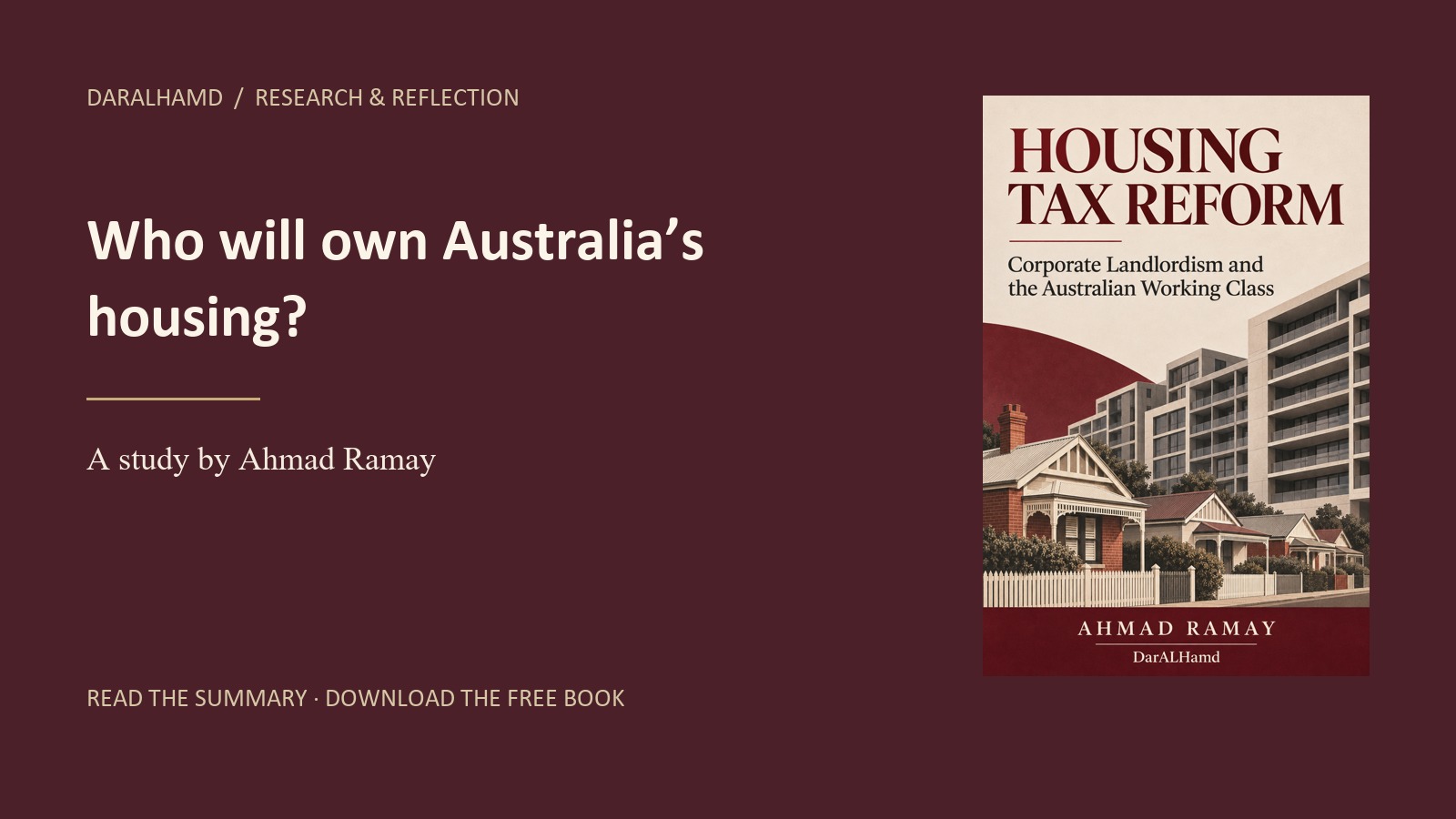
Housing reform changes more than the return on an investment. It can also change who has the cash, borrowing capacity and legal structure to participate. Ahmad Ramay’s research monograph examines Australia’s 2026 housing-tax reforms alongside build-to-rent incentives, institutional ownership and the circumstances of wage-dependent households. Its central question is whether improved affordability and additional supply can be achieved while preserving broad access to ownership and secure renting.
The financing difference
The study explains why the timing of a deduction matters. A household that must carry forward a rental loss faces a different immediate cash-flow position from a landlord with qualifying rental profits against which that loss can be used. The worked calculations are illustrative, not personal tax assessments.
Supply and ownership are different measures
A newly completed development adds dwellings. The purchase of an existing home transfers ownership of housing already built. Both affect the market, but counting investment announcements or acquired properties does not establish the number of additional homes caused by a concession.
The case for a balanced assessment
The earlier concessions did not benefit all households equally. The book considers potential gains for first-home buyers, the contribution of purpose-built rental housing and the risks of concentration. It treats bank forecasts and overseas findings as evidence with defined limits, not proof of an inevitable Australian outcome.
Conclusion
The author’s conclusion is conditional: differences in liquidity, portfolio income and statutory treatment make ownership concentration a credible question to investigate. They do not establish that institutions will dominate renting. Reform should be assessed through completed supply, access to ownership, rental affordability, tenant security and the distribution of housing wealth.
Read the complete book
Housing Tax Reform, Corporate Landlordism and the Australian Working Class · 44 pages · English · Free PDF for adult readers.
Download the free book View book details
Research scope
Policy analysis with a research cut-off of 4 November 2026. Major provisions discussed apply from future income years. This is general research, not individual tax, legal, financial or investment advice; readers should check current official guidance.
Sources and further reading
- Australian Treasury: Budget 2026–27 tax system changes
- Treasury Laws Amendment (Tax Reform No. 1) Act 2026
The complete argument, citations and qualifications are provided in the linked book. This article summarises the author’s study; it does not claim independent peer review.
Continue learning with DarALHamd Books and our free courses.

You may also like