
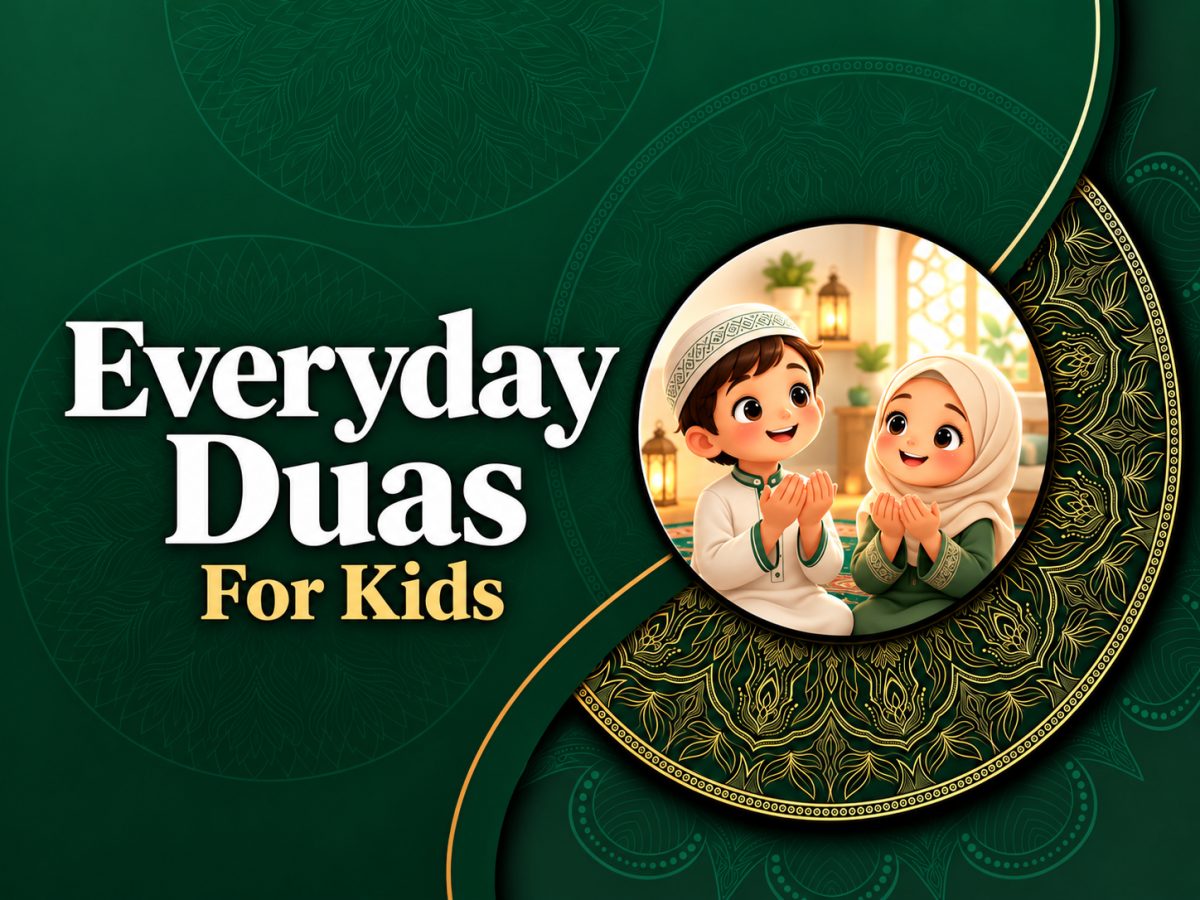
Everyday Duas for Kids
Learn fourteen distinct everyday supplications and remembrance phrases through their meanings, familiar situations and kind practice. Twelve foundation lessons are followed by four separate helper-guided chapters introducing carefully sourced Hanafi, Maliki, Shafi‘i and Hanbali guidance about supplication.
Overview
Your learning journey
Learn fourteen distinct everyday supplications and remembrance phrases through their meanings, familiar situations and kind practice. Twelve foundation lessons are followed by four separate helper-guided chapters introducing carefully sourced Hanafi, Maliki, Shafi‘i and Hanbali guidance about supplication.
Who this is for
Children aged 6–11 with a grown-up or teacher; short, untimed sessions with oral support.
What you will learn
- Match fourteen verified supplications or remembrance phrases to their meanings and everyday contexts.
- Practise verified Arabic with a qualified teacher while explaining the meaning in plain English.
- Connect gratitude, asking for help and trust with responsible everyday actions.
- Use a source reference to distinguish a Quran excerpt, a hadith reading and a personal classroom example.
- Recognise that the four Sunni fiqh schools have shared teachings, contextual rulings and sometimes differences within a school.
- Discuss differences respectfully and follow a qualified teacher consistently.
Before you begin
- No Arabic reading fluency is required; a grown-up can read the meanings aloud.
- Access to a qualified teacher for Arabic pronunciation and questions about worship.
- Paper and a pencil are enough for every activity.
01 · Remembering Allah as the day begins and ends
Discover remembrance, understand waking and sleeping words, and ask for knowledge with patient effort.
- Waking with gratitude
- Settling to sleep with trust
- Asking for knowledge and doing the work
02 · Remembering Allah around a meal
Learn what to say before food, when a beginning was forgotten, and after a meal, while practising considerate behaviour.
- Beginning a meal thoughtfully
- Remembering after a forgotten start
- Finishing with enduring gratitude
03 · Remembering during everyday transitions
Learn the different contexts of entering and leaving the toilet and leaving home, with privacy, reassurance and responsible care.
- A quiet request before entering the toilet
- A short request when leaving the toilet
- Leaving home with trust and care
04 · Kind wishes and a balanced heart
Practise a caring exchange, understand a Quranic prayer for parents, and ask for good with patience and responsibility.
- A caring exchange after sneezing
- Asking mercy for parents
- Asking for good and practising patiently
05 · Hanafi helper-guided chapter
Explore a named Hanafi answer about humility and flexibility in hand position, while respecting other learners.
- Hanafi guidance: sincerity and room for small differences
06 · Maliki helper-guided chapter
Learn how a Maliki scholarly answer reports differences within its own school, without turning them into a disagreement between children.
- Maliki guidance: a school can contain more than one view
07 · Shafi‘i helper-guided chapter
Use a Shafi‘i discussion to understand why an answer about dua outside Salah should not automatically be applied inside Salah.
- Shafi‘i guidance: the setting changes the question
08 · Hanbali helper-guided chapter
Read this lesson's summary of a narrowly framed Hanbali answer and practise distinguishing permission from obligation without judging other worshippers.
- Hanbali guidance: allowed does not mean compulsory
Sources and review notes
Source pages were opened and checked on 23 October 2026. Arabic hadith phrases were rechecked against the exact numbered Sunnah.com reports on 24 October 2026; Quran excerpts now retain the ar-uthmani-hafs text fetched through quran.ai on 24 October 2026. All English meanings are original teaching paraphrases, not verbatim translations. Readings identify excerpts and contexts. Bukhari and Muslim references use the displayed canonical numbering. Sunan Abi Dawud 30, 3767 and 5095 display Sahih (Al-Albani); Jami‘ at-Tirmidhi 1858 displays Sahih (Darussalam). These are attributed page gradings, not new independent authentication. Scholarly answers support only their stated legal contexts, and disputed supporting reports about gestures are not added to the authenticated reading collection. No transliteration or synthetic pronunciation audio is supplied. Read the Arabic and original English meanings within each lesson; external links are optional verification. Legal-summary cards identify their associated recitation separately and do not present the English legal explanation as a translation of it.
- Qualified scholarly review remains required; no lesson is claimed to be scholar-approved. Verify Arabic display, pronunciation and age-appropriate explanations before delivery.
- The four foundation chapters contain 12 lessons and 14 distinct Arabic reading texts. Three phrases belong to one sneezing exchange; sleep and waking are distinct phrases from one hadith. These are not claimed to be 14 distinct hadith.
- Separate Hanafi, Maliki, Shafi‘i and Hanbali chapters each contain one complete lesson. They teach sourced examples and interpretation boundaries, not a complete manual of any school or a combined ritual.
- The Hanafi source concerns flexibility in hand position. The Maliki source explicitly reports internal disagreement. The Shafi‘i article contains differences and disputed hadith discussions: use only its attributed contextual ruling, not a blanket authenticity claim. The Hanbali answer establishes permission in its stated setting, not an obligation or universal consensus.
- Shafi‘i and Hanbali answers were verified through attributed preserved copies on IslamQA.org. The Shafi‘i archive states its original site no longer functions; original print passages were not independently collated. A school-qualified reviewer should check the cited works and current teaching application.
- The ending of the meal supplication is rendered in a broad child-friendly sense of gifts we cannot repay and continuing need of Allah, cross-checked with the adjacent report Bukhari 5459. A teacher should explain its fuller linguistic nuances; the Arabic remains Bukhari 5458 without combining variants.
- Quran 17:24 needs sensitive teaching for different family circumstances. No learner should disclose bereavement, family conflict or religion; questions about praying for particular people go privately to a qualified scholar.
- The short lavatory protection meaning retains male and female evil beings without graphic descriptions. Do not use frightening stories or imply illness, accidents or distress prove defective supplication.
- All examples, diagrams, home tasks and quizzes are original pedagogical applications. Diagrams show meanings, context or decision-making and do not prescribe ritual gestures.
Curriculum
Curriculum
- 8 Sections
- 16 Lessons
- 10 Weeks
- 01 · Remembering Allah as the day begins and ends3 ItemsDiscover remembrance, understand waking and sleeping words, and ask for knowledge with patient effort.
- 02 · Remembering Allah around a meal3 ItemsLearn what to say before food, when a beginning was forgotten, and after a meal, while practising considerate behaviour.
- 03 · Remembering during everyday transitions3 ItemsLearn the different contexts of entering and leaving the toilet and leaving home, with privacy, reassurance and responsible care.
- 04 · Kind wishes and a balanced heart3 ItemsPractise a caring exchange, understand a Quranic prayer for parents, and ask for good with patience and responsibility.
- 05 · Hanafi helper-guided chapter1 ItemExplore a named Hanafi answer about humility and flexibility in hand position, while respecting other learners.
- 06 · Maliki helper-guided chapter1 ItemLearn how a Maliki scholarly answer reports differences within its own school, without turning them into a disagreement between children.
- 07 · Shafi‘i helper-guided chapter1 ItemUse a Shafi‘i discussion to understand why an answer about dua outside Salah should not automatically be applied inside Salah.
- 08 · Hanbali helper-guided chapter1 ItemRead a narrowly framed Hanbali answer and practise distinguishing permission from obligation without judging other worshippers.
Instructor

You May Like
Imam al-Ghazali: Revival of the Religious Sciences
Study all forty books through the complete text of Fazlul Karim’s summarised English edition, with beginner guides, Arabic vocabulary, visual learning maps and untimed revision....
Basic Arabic Alphabet for Kids
A playful first Arabic course for ages 5–9: 28 illustrated letters, 56 everyday words, 168 audio clips, fatha, damma, kasra, tracing and gentle games. No...

Easy Arabic Grammar (Quran Academy)
43 bilingual written lessons with Arabic examples, self-check exercises and source-book references. Choose Urdu or English in every class.

Assan Arabic Grammar
31 bilingual written lessons with Arabic examples, self-check exercises and source-book references. Choose Urdu or English in every class.
Introduction to Islamic Studies
Ages 7–10: 21 illustrated English lessons with interactive practice, stories, practical activities and a final learning project.
Course Features
- Lectures 16
- Quiz 0
- Duration 10 weeks
- Skill level All levels
- Language English
- Students 0
- Certificate No
- Assessments Yes